

Jorge Martin Arias: AWE Featured Student

The following essay is by Jorge Arias, student of our Psychedelic Studies program, run in collaboration with the AWE.
Walking as a Bridge: Reverence, Reciprocity, and
Relationship
Jorge Martin Arias
I entered the AWE program with a trained body and a questioning heart. For years I had practiced somatic bodywork and trauma informed therapy, guided clients in expanded states, and supported integration when life felt raw and tender afterward. I knew the maps of the nervous system. I knew how to track breath, posture, and micro movements that reveal old stories. But under all that skill was a simple fact I could not ignore: something in me was still unrooted. I felt like a tree that grew fast in shallow soil. It stood tall until the first strong wind. Then I could feel the hollowness in the trunk.
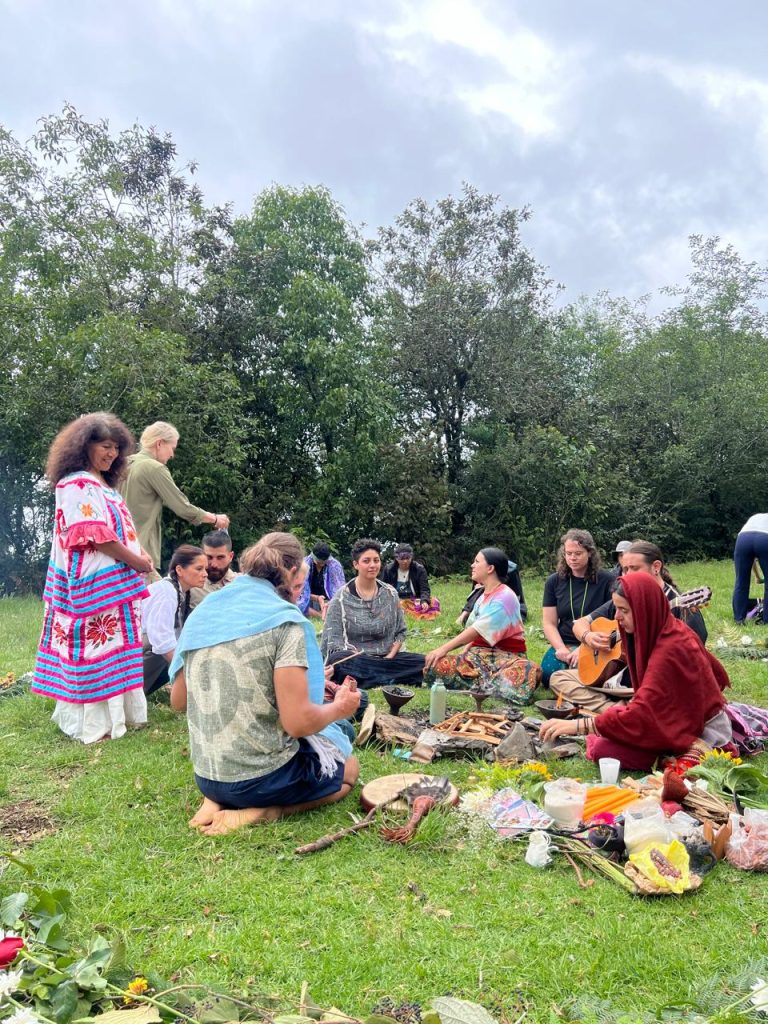
AWE did not meet me with more techniques. It met me with relationship. Three years with Indigenous and shamanic teachers reorganized my sense of what education is. The classroom broadened until it included firelight, cold rivers, dusk birdsong, and early morning silence. Some lessons arrived as words from elders. Some arrived when I carried wood in the rain and learned how to keep a coal alive through the night. Some
came when I did not speak, and finally heard what the land had been saying all along.
There is one night I return to when I ask myself what changed me. We had been in prayer for hours. The drum was steady. My mind had already tried everything it knew to stay safe. Then the body took over. My chest heaved. My arms shook. Grief moved like weather. It did not ask for permission. Images rose that were not exactly memories and not exactly dreams. Faces that felt like family stood behind me, silent and present. I could not name them. I could feel them. The lesson of that night was simple: the medicine is not here to make you feel good. It is here to make you whole.
Wholeness included parts of me I had spent years avoiding. AWE did not romanticize the word shamanic. The program turned me toward shadow. We spoke about death. We spoke about the violence of history. We asked what it means to approach Indigenous lineages as a Westerner inside cultures built on extraction. The answer was not a performative set of words. The answer was a way of walking. Listen more than you speak. Carry more than you consume. Remember that respect without reciprocity is not respect. Give back. Grow slow. When I could not find the right ritual, the right song, or the right idea, the teaching was to do the next small honest thing. Sweep the floor. Fetch water. Sit in silence. Show up again.
What surprised me most was how this orientation did not shrink my clinical skills but deepened them. When I reentered my practice at The Caring Cove, I saw the same anxiety, grief, and trauma I had seen for years. I also saw a simple pattern beneath many stories: disconnection. Disconnection from the body, from ancestors, from land, from community, from a sense of purpose bigger than self. Preparation and integration sessions shifted from being only about symptom relief to being about relationship repair. We still planned and debriefed. We also mapped who would cook for you the week after ceremony. We named the tree outside your window and the elder who taught you how to pray, even if your prayer was silence. We put a bowl of water on the table and let it remind us to slow down.
I am now leaning into my PhD in Psychedelic Studies at Ubiquity University. I used to hold scholarship and ceremony as separate worlds. AWE made that separation untenable. I still love careful research and clear language. I also know that a footnote cannot carry a fire through the night. My work is to bridge. In my research I want to explore how somatic, ritual, and community based practices complement and protect
psychedelic work. I want to write in ways that respect Indigenous knowledge without reducing it to data points. I want to ask questions that improve outcomes and protect relationships at the same time.
This matters because of the moment we are in. Psychedelics are moving fast into clinics, businesses, and the public imagination. I welcome the relief they can bring. I am also cautious. Without roots, this wave can repeat the harm it hopes to heal. Medicines can turn into products. Lineages can turn into branding. Safety can be defined only as the absence of symptoms instead of the presence of relationship. The alternative is
simple and hard. We can choose reciprocity over extraction. We can choose to practice
in a way that leaves more living connection behind than we found.
AWE taught me to ask better questions. What is the agreement I am in with the land where I work. What is my responsibility to the lineages that made my work possible. How do I make my practice affordable without devaluing the labor that sustains it. How do I remain teachable. How do I set boundaries that protect the work without closing my heart. These questions do not have final answers. They are a form of prayer in motion.
The most practical change in my sessions is simple pacing. Slower. More contact with the body. More time to name what feels true and what does not. When a client tells a story, we study how the story travels through breath, face, spine, and hands. When someone feels pulled toward a big medicine experience, we ask what they hope will change, what they fear will not change, and what will almost certainly stay the same.
We map supports. We involve trusted people. We plan time for rest and care. We talk openly about risk. We do not outsource safety to dosage or set and setting alone. We include community, food, sleep, time off, and the honesty of daily life.
I also teach small groups. AWE encouraged me to move from the helper identity toward the neighbor identity. In groups we cook, sing simple songs, and share work that does not have a price tag. We make altars with stones and flowers from the block. We practice sitting in silence and in sound. We name our dead. We talk about the truth that grief and praise are twins. The goal is not to create a perfect container. The goal is to remember how ordinary community can carry extraordinary weight.
There is another scene that lives with me. It was early morning after a long night. The fire was mostly coals. Someone handed me a small bundle of cedar and said, keep this alive. I sat there feeding the coals, one thin stick at a time, feeling foolish and holy. That is what much of this work feels like now. Small, steady actions that keep a living heat available for the people who will need it later. Some days that looks like reviewing
research. Some days it looks like walking in the park and offering a simple prayer. Some days it looks like making soup for a friend who is grieving.
I am grateful to the elders and teachers who carried these ways through hard times. I am grateful to the land and the medicines. I am grateful to the peers who walked with me and told me the truth when I wanted comfort instead. I am grateful to Ubiquity for an academic home where I can write and research without setting down the drumbeat in my chest.
If I had to name what I am taking forward, I would use three words. Reverence. Reciprocity. Relationship. Reverence means I remember I am not the center. Reciprocity means I give back at least as much as I receive. Relationship means I measure success by the quality of connection that remains after the session ends, after the retreat ends, after the degree is complete.
Education became initiation for me. The work now is simple. Keep the coal alive. Serve the people in front of me. Study. Practice. Pray. Tell the truth. Protect what protects us. And when I forget, return again to the ground, to breath, to the questions that brought me here.

Responses